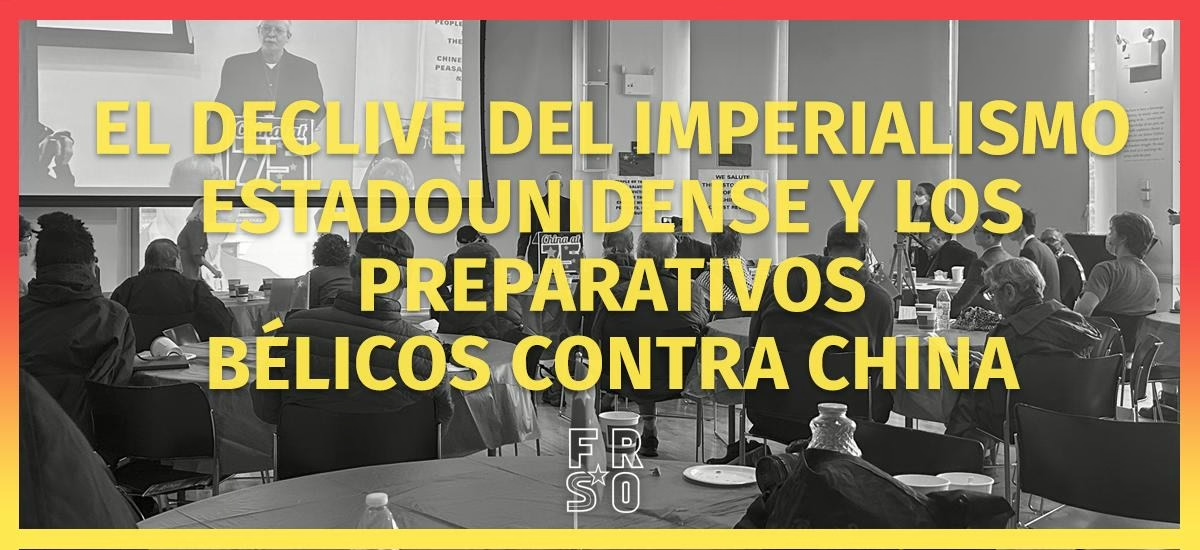
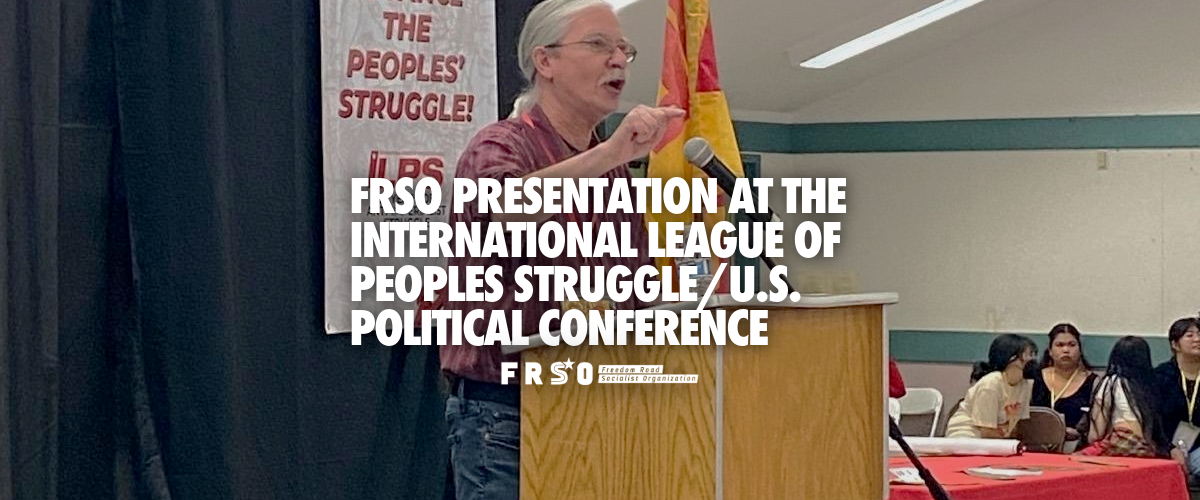
The following is a keynote speech delivered by the Freedom Road Socialist Organization Political Secretary Mick Kelly, May 31, at the International League of Peoples Struggle/U.S. Political Conference.
Comrades and friends
Let me start by thanking and congratulating the organizers of this genuinely important event, the Third National Assembly of the International League of Peoples Struggle/U.S. What a powerful gathering! This is truly a room full of militants. Many of us have worked together for years and all of us are consistent anti-imperialists.
In the words of the outstanding revolutionary Jose Maria Sison, the late chairman of the ILPS, “imperialism is the last way out for the monopoly capitalists to postpone their revolutionary overthrow. It means the extension of the class oppression and exploitation within the United States into the oppression and exploitation of other nations and people abroad through the export of surplus products and surplus capital.”
The implications of this are clear enough. Working and oppressed people in the U.S. and abroad have a common interest in ending imperialism. We want this to happen as soon as possible. The decline of U.S. monopoly capitalism, or imperialism, the two terms can be used interchangeably, is accelerating. The decline is picking up speed and we welcome its demise. And we intend to throw gasoline on the fire.
I will be talking today about strengthening and broadening the people’s movement, especially the workers movement in the United States, as well as the key role of workers in the fight for democracy and the struggle to achieve socialism.
Also to be addressed is the state of the labor movement and what we need to do to move the level of struggle of the working class to a higher level. Finally, I will be looking at the issue of international solidarity.
Need for a mass line approach
To be successful as anti-imperialists, as revolutionaries, as people who want to and will change the world, we need to apply the mass line. While there is a lot that could be said about that, at the heart of it is “from the masses, to the masses.”
Or to quote the great Chinese revolutionary Mao Zedong, “In all the practical work of our Party, all correct leadership is necessarily ‘from the masses, to the masses.’ This means: take the ideas of the masses (scattered and unsystematic ideas) and concentrate them (through study turn them into concentrated and systematic ideas), then go to the masses and propagate and explain these ideas until the masses embrace them as their own, hold fast to them and translate them into action, and test the correctness of these ideas in action.”
To put this another way, we sum up where people are at. Basing ourselves on what people are concerned about, on what folks want, we develop slogans, policies, plans, that people will take up as their own. It is in this way that revolutionary theory becomes a material force.
All of us who do organizing can appreciate the point that Mao was making. The starting point of our organizing needs to be where people are at – what their actual level of political development is. We are not organizing people in books or people who are the way we imagine they should be – we need to connect with people where they are at and systematically lead them forward.
One thing about capitalism is that it is an excellent teacher. For anyone who thinks that this system is fair, reasonable, or just, the capitalists, really the system itself, is always ready to teach you otherwise. It’s an endless disappointment, a Christmas that never comes. Capitalism is a failed system, but to help people gain that understanding – and understand who is the enemy and what is to be done – we have to be standing right next to them summing things up.
The accelerating decline of U.S. imperialism
The decline of U.S. imperialism is picking up speed. The U.S. share of world trade in goods has declined about 40% since 1970. The U.S. share of world GDP is about half of what in the aftermath of World War II. The U.S. has retreated from the economic architecture that underpinned the so called, “American Century.”
In recent years, management of the declining U.S. empire has been bipartisan. Both Trump and Biden disengaged from the WTO and adopted measures to “delink” the economy from China. While there are significant differences between the industrial policies of Trump and Biden, neither embraced a “let the market decide”, laissez-faire approach that’s touted by neoliberals
The decline of U.S. imperialism is sharpening all of the basic contradictions present in society: the contradiction between the monopoly capitalists and the multinational working class; between the ruling class and oppressed nationalities; and between the monopoly capitalism and women and LGBTQ people. This provides the material basis for the intensification of polarization, and the phenomenon of different states or even cities having different legal systems which accord people varying democratic rights.
The sharpening of the contradictions is in sharp relief in the fight for immigrant rights. Our organization views the attacks on immigrants as a function of national oppression, which means that the U.S. is a jailhouse of oppressed peoples, of oppressed nationalities.
Militarized ice raids and troop deployments to major cities is serving to pull U.S. society apart, and this can be seen in mass protests and rebellions (LA and Minneapolis), divergent court rulings, a degree of non-compliance by some state and local authorities (Chicago).
One aside here. After the murder of Renee Good in Minneapolis, I arrived on the scene about 15 minutes after the killing took place. The car she was killed in was still there. And sure, there was sadness. But there was also anger. Repression gives rise to more resistance – so there were many clashes with the ICE agents.
But back to the decline of U.S imperialism and sharpening contradictions.
On a different level, and more reflective of contradictions in the enemy camp, are the government shutdowns that are becoming more frequent and larger with the passage of time. Then there are the impeachment attempts. And then there are the things that are not normal in modern U.S. politics, such as the “weaponization” of the Department of Justice and the prosecution of Trump’s bourgeois political opponents. One feature of the Trump administration is a willingness to push up to – and beyond – the limits of bourgeoisie legality.
Any major economic downturn or crisis will sharpen the aforementioned contradictions. The capitalists will act the way they always do – try to shift the burden of the crisis onto the backs of the working class. Most state governments (and many local ones) will experience budget crises, resulting in attempts to push austerity measures.
A scientific analysis of changes in society grasps the fact that changes in the economic base (productive forces and relations of production) will result in the superstructure (politics, government, religion, etc.) changing. And that the superstructure will alter the economic base, meaning that there is a dialectical relationship between the two. This is not a one-way thing either; certain changes in the superstructures can play a crucial role in the economic base.
Lenin made the point that monopoly capitalism was moribund – capitalism in the period of terminal decline and decay. As such, monopoly capitalism has challenges utilizing advances in science and deploying more advanced productive forces in general.
Taken as a whole, these objective conditions provide extremely favorable conditions for revolutionaries, progressives, and anti- imperialists to greatly expand our mass base and organizational capacity.
Building the workers and other popular movements
The working class is a class in itself; its existence is objective, and developing class consciousness means the working class becomes a class that is for itself. While it is true that the task of developing the workers movement in the U.S. is not identical with revitalizing the trade union movement, organized labor has a critical role.
The fact of the matter is that many of our trade unions, most really, are not only bureaucratic, they’re conservative and they often have a “go along to get along” approach when it comes to dealing with employers. This needs to change. So work needs to be done to put trade unions on a class-struggle basis. Practically, this means building up militant minorities in the form of caucuses or reform slates and contending for leadership.
We need more serious confrontations with the employees, such as the strike by 1,500 Teamsters last year at the University of Minnesota or the strike of packinghouse workers in Greely, Colorado.
The center of gravity for work in the labor needs to be wages and working conditions. Given that the working class is multinational and has more than one gender – there is also the fight against discrimination and inequity in our workplaces. To strengthen and broaden the working class movement. The starting point needs to be the “felt” needs of workers.
If we fail to do that, our efforts to raise the level of class struggle with fail. But starting points are not ending points and we cannot say that we must confine ourselves to immediate needs – our class is multifaceted and we need to address political issues as well.
A stellar example of this was the labor-initiated anti-ICE protest in Minneapolis, where nearly 100,000 people took to the streets on January 23. Some people say it was a general strike – it was not – but it is a wonderful example of what is possible when labor movement chooses to act. Actions such as this, in a very nascent or beginning form, give life to the concept of “Workers unite to lead the fight against all oppression.”
Strengthening and broadening the people’s movements
Mao Zedong once remarked there is “Great disorder under heaven – the situation is excellent,” That is a spot-on description of how revolutionaries should view the situation in our country today. It in no way implies indifference to real suffering that is the day-to-day experience of our class, of working and oppressed people at home and abroad. Instead, Mao’s statement gives correct stress to favorable conditions we find ourselves in to build large mass struggles.
It’s been said before and it can be said again – the U.S. is a prison house of oppressed nations, and the oppression visited upon African Americans, Chicanos and others is in fact national oppression.
The struggle against national oppression is a struggle against imperialism, against monopoly capitalism… so let me give a shout out to the members of the National Alliance Against Racist and Political Repression who present here today. Your efforts to stop police terror, for community control of the police and in defense of voting rights are inspiring. Same goes for those of you in Centro CSO Chapters who are resisting ICE and have faced real repression. And an additional point on that – there is a grand jury meeting in Santa Ana, California – we reason to believe that it may well be targeting immigrant rights activists. If that proves to be the case, we will be certainly calling on all of you for support and solidarity.
Here we are, five years after the George Floyd Rebellion, the greatest wave of urban upbringings since the 1960s and early 70s. In those weeks in late May and early June 2020, nearly 25 million people took to the streets.
That powerful mass motion against police crimes and systematic inequality – national oppression – gave lie to the idea that conditions in the U.S. were immutable, that nothing changes. Anyone present at the burning of the Third Precinct building in Minneapolis can tell you this. Late in the evening of May 28, 2020, the last police, who had been firing rubber bullets and tear gas rounds, disappeared. There were thousands of people in the streets. Then the building went up in flames, Things do not have to stay the way they are. And they will not.
United front against imperialism
The U.S. working class is multinational; it is like a mosaic. There are also the movements of the oppressed nationalities. Real change in the U.S. requires a united front against imperialism, against monopoly capitalism. At the core of this united front needs to be a strategic alliance of the multinational working class and of the oppressed nationalities. Around this will be an alignment of other classes in conflict with capitalism, other sectors with particular importance, like women and LGBTQ folk, and social movements such as those who resist U.S. wars.
Together we will be unstoppable!
Democracy and democratic rights
Democracy does not exist in the abstract, its mode of existence, and how it is practiced in the real world is always in the context of the existing class relations.
Every discussion of the topic should start with the recognition that a capitalist democracy is a cash register democracy where the amount of rights one has and the amount of power one has is directly linked to one’s class position. And that Lenin was entirely correct to say that a capitalist democracy is a democracy for slaveholders at the expense of the enslaved.
That truth no way negates the fact the struggle for consistent democracy and democratic rights is extremely important in the U.S. today. For purposes of exposition, I am going to treat these topics as two categories, but they are two aspects of the same thing.
The absence or limitations on consistent democracy is an important feature of racist national oppression, and it needs to be combated with all energy we can muster. For example, the attacks on voting rights are disenfranchising millions of African Americans. Consistent democracy is the equal treatment of languages, especially on matters of government. On the national level the U.S. is adopting a chauvinist “English only” model. These are examples and further examples could fill volumes, everyone here knows that. But here is another point: by being frontline fighters in the fight for democracy we can rally millions to the fight for revolutionary change.
Travel around this country and you can see that the legal superstructure is moving in different directions. You have different democratic rights (say, reproductive rights and the rights of LBGTQ people) in different places. As political polarization sharpens, this country is fracturing. And that is not a bad things from the standpoint of revolutionaries – because we intend to take it apart and put an end to U.S. monopoly capitalism once and for all.
There is also the aspect of defending democratic rights and civil liberties. We all get that the U.S. is a repressive place. Arguably it always has been – lynch terror in the Black Belt South to buttress semi feudal property relations (sharecropping), the concentration camps for Japanese Americans during World War II, and communists jailed or deported in the 1950s. This is, and always has been, a repressive place.
That said, it is clear that a major assault our rights to organize, associate and demonstrate is underway. It is a danger that needs to be confronted. The state of Florida is criminalizing Palestine protests. Conor Cauley, an organizer for Palestine and member of the International Longshoremen’s Association, is sitting in jail today – serving a 60-day sentence for a felony that did not happen. Over the past year, hundreds have been charged with felonies in the anti-ICE protests around the country. And all sorts of reactionary and repressive legislation is moving forward in Congress, states, and cities.
In all cases we need to push back against the assault on democratic rights, but there is one attack on those rights which dates from the Clinton era – the Antiterrorism and Effective Death Penalty Act of 1996. This bill borrowed a page from apartheid South Africa and put the tag of “terrorist” on those fighting for national liberation. These “material support for terrorism” laws are reactionary, should be abolished and should be opposed by every person who stands for progress.
Working class internationalism
All of us, every, single one of us here, believe that working class internationalism and international solidarity are important. Every blow against U.S. imperialism ,be it in Palestine, the Philippines, or for that matter, Philadelphia ,weakens our common enemy benefiting the people at home and abroad.
We are all in this together and none of us can be free, while oppressing others.
We always must make sure that international solidarity is not just things we say, but it is alive in the things that we do. Right now, the U.S. empire is waging a war on Iran. Paper tiger that it is, the U.S. Trump administration is being defeated, humiliated in fact. Our task here is to unite all who can be united to oppose the war, and in cities around the country many of you have been doing exactly that.
There are other forms of international solidarity. Many have traveled on exposure trips to occupied Palestine and have been about to report back on the efforts of the national democratic force. We can work to promote solidarity between labor unions in this country and those under the boot of U.S. imperialism. Same goes for solidarity organized by sectors. All these methods can be employed and others too.
“Workers and oppressed people of the world unite,” is something all of us take seriously.
Socialist future
Mao once said that only socialism can save China. You know what? Only socialism can save the U.S. Monopoly capitalism is a failed, sick system that evokes alienation and anger.
The multinational working class has a material interest in bringing this system to an end, but hard work is needed to develop the understanding, political clarity, and capacity to do this.
In my view we will need to establish a new communist party that is capable of contending for power. I understand fully that this is a gathering of mass organizations, but I also know that questions of “How do we end imperialism?” or “How do we abolish the existing order of things?” are on the minds of many of you here.
So, in closing, I have been active in people’s struggle for more than 50 years. Never have I been as hopeful as I am now. Capitalism is a vicious blood-sucking system that drains the life blood out of the working class. Marx compared the big capitalists to vampires. He was right about that. And what do we do when we encounter a vampire? We drive a stake through its heart.
And on that note, comrades, thank you. Our future is bright and we have a world to win.
Long live international solidarity!